
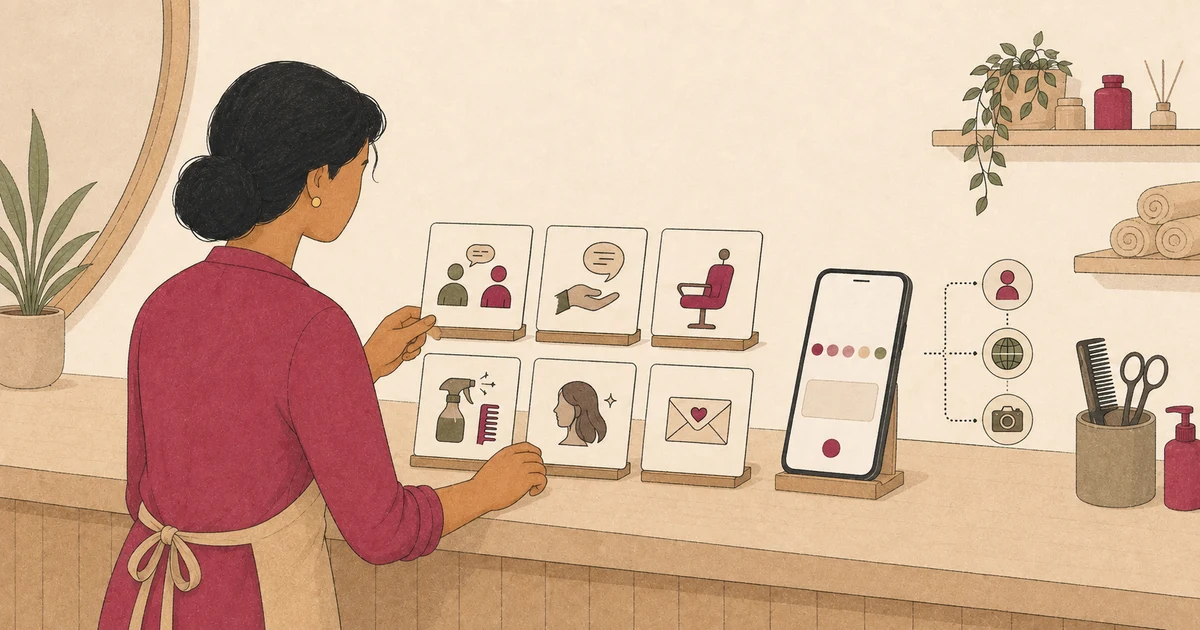
“How was your salon visit?” sounds friendly, but it rarely tells a team what to keep, fix, or discuss. A single star rating cannot show whether the issue was the consultation, waiting time, comfort, cleanliness, communication, or finished service.
A useful salon feedback form separates those moments without turning the appointment into an interrogation. It uses neutral wording, asks only questions the salon can act on, and keeps private feedback separate from any public review or social-media permission.
This guide gives Indian salons a practical eight-question starting set, service-specific variations, and a simple follow-up workflow.
Decide what the form should help you improve
Start with a decision, not a list of everything you could ask. A neighbourhood salon may need to understand whether clients felt heard during consultation. A multi-branch team may need comparable feedback about waiting, explanation, comfort, and the result.
Write down who will read each answer and what they can change. If nobody will use a question, remove it.
The Australian Bureau of Statistics' forms design standards recommend simple, precise wording, balanced answer choices, and testing. They also warn against leading questions and questions that combine separate ideas.
That matters in a salon. “Was your stylist friendly and skilled?” cannot tell you which part the client is rating. “Did you love your new look?” assumes a positive result. Ask one neutral question at a time instead.
Use one core form across the business, then add no more than one or two questions for the booked service. India's Beauty & Wellness Sector Skill Council currently lists separate qualification packs for hair dressing, beauty therapy, nail services, and spa therapy. Your feedback form can reflect those different experiences without becoming a different survey for every treatment.
Start with these eight salon feedback questions
Use this as a starting set, not a script that every salon must copy unchanged.
- Which service did you visit us for? Offer broad options such as haircut or styling, hair colour or treatment, beauty service, nails, grooming, bridal or occasion styling, and other.
- Before the service, how clearly did the team understand what you wanted? Use a balanced scale from “Very clearly” to “Not clearly”, plus “We did not discuss this”.
- How clearly was the expected result explained before the service? Use the same scale so the answers are easy to compare.
- How comfortable did you feel during the appointment? Offer “Very comfortable”, “Comfortable”, “Neither”, “Uncomfortable”, “Very uncomfortable”, and “Prefer not to answer”.
- How clean and ready did the work area appear? This asks about what the client observed; it does not ask them to certify a hygiene process they cannot see.
- How satisfied or dissatisfied were you with the finished service when you left? Include both satisfied and dissatisfied choices rather than presenting only positive options.
- What, if anything, worked especially well during your visit? Make this optional.
- What, if anything, should we improve for your next visit? Make this optional and leave enough space for a useful answer.
These questions move through the visit in a recognisable order: service, consultation, explanation, comfort, work area, result, strengths, and improvement. Asking soon after the appointment also reduces the amount a client must reconstruct from memory; the ABS guidance recommends keeping the reference period as short as possible to reduce memory bias.
Do not finish with a compulsory public-review question. If the salon provides a Google review link, show the same optional path independently of the answers and expected rating.
Add only questions that fit the booked service
A short service module makes the form more relevant while preserving a comparable core.
For a haircut or styling appointment, add one of these:
- How closely did the finished style match what you agreed during the consultation?
- How clear, if at all, was the advice for caring for the style at home?
For a hair colour or chemical service, ask whether the process, expected result, and after-care were explained. Do not combine all three into one scored question if the team needs to know which explanation was missing.
For a beauty, grooming, nail, or spa service, ask one relevant question about privacy, positioning, comfort, or after-care. Avoid requesting health details in a general feedback box. Give clients a monitored private route for a reaction, injury, or other concern that needs prompt attention.
For bridal or occasion styling, ask whether timing and the agreed brief were handled clearly. Keep any request to use a before-and-after image, name, handle, or quote out of the feedback score.
The B&WSSC's current Hair Dresser & Stylist qualification pack treats work-area preparation, client service, health and safety, and communication as separate parts of the role. That separation is useful when deciding which salon moment needs its own question.
Use answer choices that do not push towards praise
Balanced answer choices are easier to interpret than “Good”, “Great”, and “Excellent”. For satisfaction, use a five-point scale with clear opposites:
- Very satisfied
- Satisfied
- Neither satisfied nor dissatisfied
- Dissatisfied
- Very dissatisfied
Add “Not applicable” when a client may not have experienced the thing being asked about. Do not force a rating for a consultation that did not happen or after-care that was not relevant.
Keep the direction of the scale consistent throughout the form. If the most positive choice appears first for one question, do not reverse the next question merely to catch inattentive responses.
Use plain language that staff and clients would say naturally. “How clearly did we explain the service?” is easier than “Evaluate the adequacy of pre-procedure communication.” Translate the form when that helps your clients, but have a fluent speaker check that the translated options remain balanced.
Open-text questions should be optional. A client who has already answered six structured questions should be free to submit without writing an essay.
Separate feedback, follow-up, reviews, and photo permission
One response can involve four different choices. Keep each choice visible and independent.
Private feedback: The client answers questions for the salon. Explain who will review the response and avoid asking for appointment, payment, or health details you do not need.
Private follow-up: Ask, “Would you like the salon to contact you about this response?” Show an optional phone or email field only when the client says yes. Do not reuse that detail for unrelated promotion.
Public Google review: Google's current Maps content policy prohibits discouraging negative reviews or selectively asking only positive respondents to review. It permits neutral requests based on genuine experiences when the business does not offer incentives or influence the rating or wording.
Google also explains that submitted reviews may appear publicly and can be attributed to the contributor's profile. Tell clients that a Google review is public before they follow that path, and remind them to omit details they do not want public.
Photo or testimonial permission: A private comment is not a blanket approval to publish a name, quote, photo, handle, or before-and-after image. Ask separately for the exact asset and final use. Meta's Instagram guidance says businesses should post content they created or have permission to use and notes that written permission is generally advisable.
Choose a respectful moment and channel
Offer the form after the booked service is complete, when the client can respond without a stylist or receptionist watching. An exit card can work if it is clearly optional. A post-appointment message lets the client answer later.
If you send the link through WhatsApp, use an expected service conversation and respect the client's communication choice. WhatsApp's current Business Messaging Policy requires the recipient's number and opt-in permission for subsequent messages, and requires businesses to honour opt-out requests.
Identify the salon or branch, refer only to the completed appointment in general terms, send one clear invitation, and give the client an easy way to decline further messages. Yeeto's guide to Google review request messages for WhatsApp has adaptable wording and channel safeguards.
Do not send a stronger reminder because someone left a critical private answer or ignored the first request. A feedback form should not create pressure.
Turn answers into a weekly salon routine
Collecting responses is useful only when someone reviews them. Assign one owner and use a short weekly routine:
- Read new responses and separate urgent follow-up from routine themes.
- Contact only clients who asked for a response, unless a genuine safety or service obligation requires another approved process.
- Group comments by consultation, timing, communication, comfort, cleanliness, result, and after-care.
- Compare like with like: haircut answers with haircuts, nail answers with nails, and branch answers with the correct branch.
- Choose one change the team can test, such as explaining expected colour results more clearly or checking the waiting-area handover.
- Record the owner and review date, then close the loop with the client when appropriate.
Do not turn individual staff mentions into public-review targets. Do not ask clients to revise a public rating in exchange for corrective work. Resolve a valid service issue because it needs resolving, while leaving the client's public words under their control.
A customer feedback process can keep structured answers and follow-up context together. The salon still owns the judgement, response, and service improvement.
Test the form before sharing it widely
Run the complete form on a phone. Check that the service list matches actual bookings, every scale has clear opposites, optional fields are visibly optional, and the correct branch receives the response.
Ask a receptionist and a service professional to explain what action each question could trigger. Then pilot the form with a small set of willing clients without requesting a positive answer. Watch for confusing terms, missing “Not applicable” choices, and forms that feel too long.
Review the questions after a month. Remove items that produce no decision, split questions that hide two issues, and keep the wording stable when comparison over time matters. Never promise that a questionnaire will guarantee ratings, reviews, retention, or revenue.
Next step
Begin with the eight-question core, add one service-specific question, and test the flow after one real appointment type. Make private follow-up, public reviews, and image permission separate choices.
Yeeto Review App's salon feedback workflow can help you share focused questions through a branded QR code or link and keep responses in one inbox. Clients provide the experience, control their words, and decide whether anything is shared.